Instruction Conflict Failures in Agents With Multiple System Prompts
Multi-agent systems silently follow the wrong instruction while appearing to succeed.
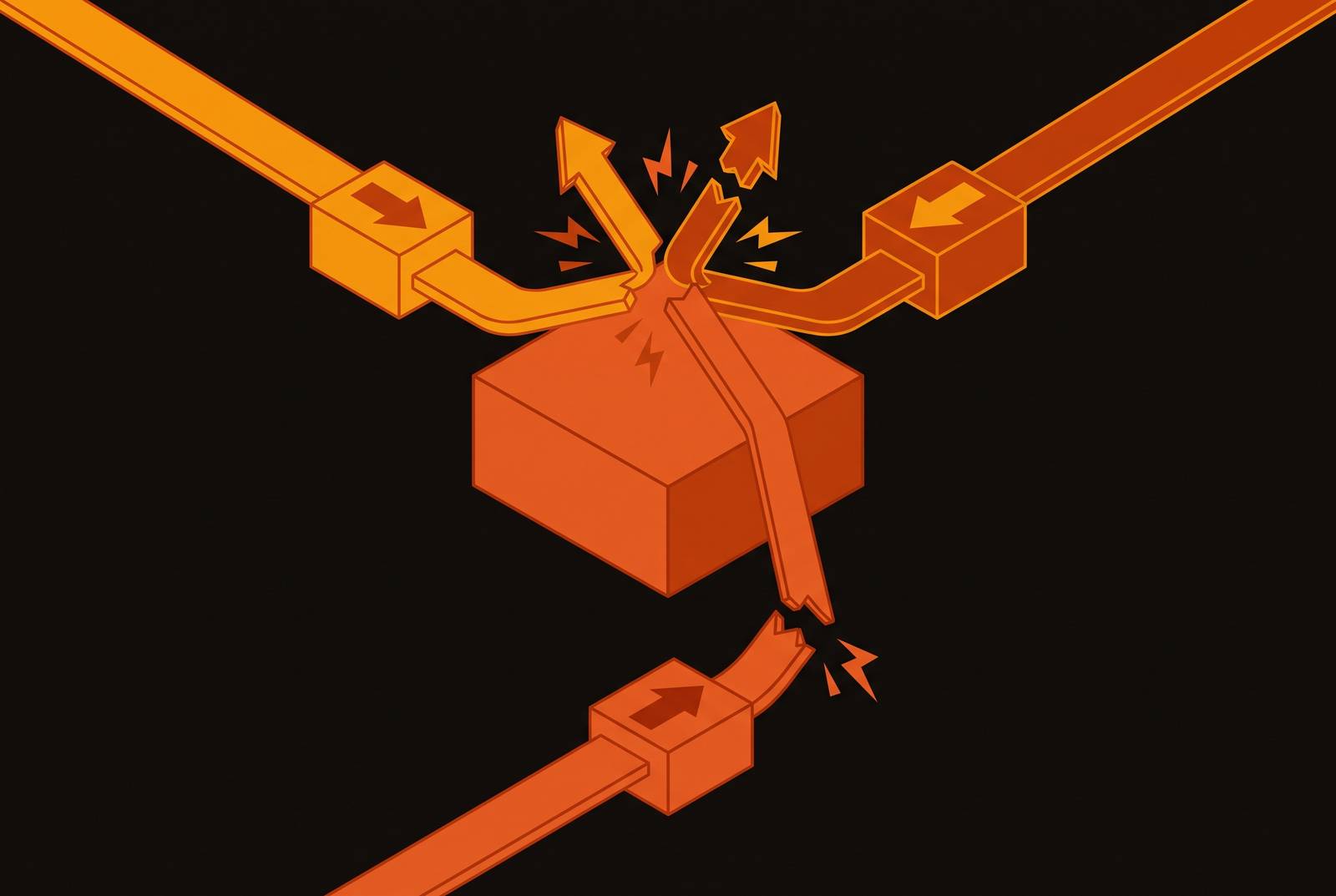
Agents with multiple system prompts can follow the wrong instruction while appearing to complete a task successfully. Conflicting prompts are resolved invisibly. Engineers need monitoring that checks execution against the active instruction set and tracks decisions across agent boundaries, because successful responses alone do not show that the system behaved correctly.
Why agents with multiple system prompts fail in ways that look like success
A support agent escalates a refund request while a compliance agent simultaneously blocks it. Both return success, and each appears to have acted correctly within its own instructions. Yet their combined behavior does not amount to a coherent resolution of the request. The failure is a confident, well-formed response that satisfies the wrong instruction. Because neither agent surfaces the contradiction, the engineer and the user receive no clear signal that anything went wrong.
The International AI Safety Report 2026 notes that when agents have more autonomy and work on long-running tasks with little human oversight, there are more chances for context manipulation and misaligned execution. The 2025 AI Agent Index finds that most agent developers share little information about safety, evaluations, and societal impacts. With so little shared, there is little on record about how these systems behave, even as they have more chances to stray from what they should do.
How models actually handle conflicting instructions — and why the result is unpredictable
Several sources compete to govern the same action. Models have no priority rule they are sure to follow when choosing among orchestrator, sub-agent, tool, and user-turn instructions. Instead, whichever instruction has more contextual salience at inference time tends to win. That salience is not stable, so even simple, clearly verifiable formatting conflicts produce inconsistent choices. Models also rarely point out the contradiction, so how sure they sound says little about how well they resolved it.
Positional bias makes this especially difficult to diagnose by inspecting whether a prompt contains the right words. Instructions in the middle of a long prompt receive less attention weight than instructions at the beginning or end. A safety constraint buried between tool descriptions can therefore be received by the model but effectively ignored. As context windows grow and conversations lengthen, instruction-following capabilities degrade further.
When a model recognizes a conflict, it typically chooses an instruction and proceeds without flagging the choice or asking for clarification. Kwan Soo Shin’s The Compliance Gap reports that, under default framing, all six frontier models have instruction compliance rates of 0% for process instructions.
Separating instructions from data does not remove this difficulty. Abdelnabi et al. 2026 argues that agents find instructions throughout the context they work in, including memory, tool schemas, third-party interactions, and user turns. These sources are built to give instructions as well as hold information. A boundary that excludes their instructions can also break the workflows the agent is meant to perform. Rewriting an ambiguous prompt alone leaves these structural conflicts unresolved.
Where in a multi-agent system the conflict actually forms
The first seam lies between the orchestrator and the sub-agent. The orchestrator sets the scope and constraints, while the sub-agent’s role prompt tells it how to act within its domain. Their instructions can overlap on scope boundaries, escalation rules, or data-handling policies without agreeing on what should happen. When they contradict each other, neither agent has a guaranteed way to establish which definition governs. Local role compliance can consequently depart from the system’s intended behavior.
The tool layer adds another seam because retrieved tool descriptions and tool schemas also give instructions. An agent’s ability to use a tool and the tool’s agreement with the constraints already governing the task both matter. MCP server declarations create a further instruction-bearing boundary. They enter the same operating context as other directives, without guaranteeing a predictable resolution when those directives conflict.
User-turn injections form the remaining seam by introducing directives into a context already shaped by the other layers. The user turn does not arrive in isolation, so its meaning and effect depend on the instructions around it. All four seams can be active simultaneously in a production system. Specification drift compounds that exposure as orchestrator prompts evolve, tool schemas change, and retrieved content expands. The conflict surface can therefore grow without an explicit architectural change or the team recognizing that its instruction relationships have changed.
What the MAST taxonomy reveals about where multi-agent failures cluster
MAST gives engineers a diagnostic vocabulary for failures that otherwise look like unrelated bad outcomes. Cemri et al., NeurIPS 2025, UC Berkeley, annotated execution traces across 7 popular multi-agent frameworks using 6 expert annotators, with 3 conducting inter-annotator validation. The work identified 14 fine-grained failure modes across three clusters. The overwhelming majority of multi-agent failures originate in specification and coordination failures. Better models alone therefore do not address the main source of these failures.
That distinction changes what an investigation needs to explain. A specification problem concerns what the system told its agents to do, while a coordination problem concerns how their work fits together. The diagnostic value lies in locating the failure in the instructions or their interaction, rather than treating every wrong outcome as an isolated model mistake. Execution traces matter because they expose the sequence in which those problems take effect.
AgentRx, arXiv 2602.02475, 2026, adds a complementary cross-domain view of execution trajectories. Its taxonomy names instruction/plan adherence failure as a distinct category covering both under-execution and over-execution. Under-execution means the agent does less than it was told to do. Over-execution means it takes unplanned actions, such as extra tool calls, that violate the plan, domain policy, or orchestrator constraints. The distinction makes clear that more activity can be a failure just as readily as missing activity.
An agent can act within its local instruction context and still contribute to a wrong outcome. Evaluating that action only against the agent’s immediate role misses the relationship between its behavior and the wider task. These categories are useful because they give engineers names for that gap. They also show why error monitoring that checks one operation at a time cannot fully explain it.
Why instruction hierarchy fixes are less reliable than they appear
A strict priority order is an intuitive response to conflicting instructions. If the orchestrator outranks the sub-agent and the system prompt outranks the user turn, the intended authority appears clear. That ordering is useful as a statement of design intent. A declared hierarchy can diverge from enforcement at inference time. Treating the two as equivalent creates confidence that the execution behavior does not justify.
Abdelnabi et al. 2026 shows that data-instruction separation fails to detect attacks based on contextual manipulation and can degrade contextually appropriate behavior. The practical tension is that a fixed prohibition may block a legitimate flow, while permission may admit a conflicting flow made to appear appropriate by its context. Tightening the boundary does not eliminate the need to interpret that context. Although the paper deals with adversarial behavior, the same difficulty arises when valid instructions conflict. A static hierarchy cannot correctly settle every case merely by assigning authority to a source.
Long-running autonomy introduces a separate limit. By the time a sub-agent makes a consequential decision, the orchestrator’s original constraints may no longer be in the active context window. The hierarchy still exists in the system design, but the information needed to apply it has decayed at inference time. There is also a complexity cost to the architecture itself. Simpler single-agent baselines with the same tools and retrieved context often do as well as or better than multi-agent workflows, so adding agents can add conflict surface without making the system more capable.
These limits make hierarchy insufficient as the sole defense against instruction conflict. Design-time rules describe how execution should proceed, but they do not establish how a particular run actually proceeded. That difference is why runtime detection remains necessary even in systems with carefully defined prompt priorities.
Why traditional monitoring cannot see these failures
Traditional application monitoring and logging were designed around deterministic services where the same input produces the same output. An agent can follow the wrong instruction and still return HTTP 200. Its trace can show a completed tool call without showing which instruction governed that call or whether it was the right one. The status is accurate about completion but silent about compliance.
Diagnosing compliance becomes harder across agent boundaries when Agent A decides X, and Agent B proceeds on the assumption that X is true, although X was wrong. Both agents can return successful responses. Conventional logging cannot attribute this pattern to a single error-producing component because neither component produced an error. The failure lies in transferring a false premise between operations that may each function correctly.
Intent creates a further blind spot. A log records what an agent did, but not what it should have done under the specific combination of instructions active at that moment. The coding-agent study on arXiv examines tens of thousands of real-world sessions in which developer-agent intent diverged, with misalignment made visible through explicit developer pushback or correction. Without comparable evidence, an action record alone cannot distinguish correct execution from compliant-looking misbehavior.
The International AI Safety Report 2026 notes that monitoring agents’ interactions with external tools and other agents would allow more effective oversight. Those interactions are precisely where a locally successful action can carry a conflict into later work. An agent that silently fails or crosses a policy boundary can cause cascading errors before an alert fires. Monitoring must therefore examine the relationships between instructions, actions, and handoffs, rather than infer correctness from an absence of errors.
What monitoring must actually catch at the trace level
The first requirement is trace-to-intent alignment. Every execution trace must be checked against the agent’s actual instructions at that point in execution, as well as checked for successful tool calls. This requires capturing the prompt stack as part of the trace alongside the model’s output. Otherwise, the monitoring layer lacks the context needed to judge whether the action followed the governing instruction set. Monitoring must verify behavioral adherence independently of the agent’s claim that it complied.
The second requirement is cross-agent conflict attribution. When one agent’s decision becomes another agent’s false premise, monitoring must reconstruct that causal chain across agent boundaries. Session-level traces are necessary because per-agent logs divide the failure at the point where its explanation depends on connection. The third requirement is automatic deviation grouping. Unanticipated instruction combinations make exhaustive upfront failure definitions insufficient, so monitoring must surface recurring deviation patterns from production traces.
OpenTelemetry GenAI provides an emerging structural layer for this instrumentation through client spans, agent and workflow spans, MCP conventions, events, metrics, and provider-specific attributes. That structure supports intent-aware monitoring, but recording the structure is not itself a judgment about instruction adherence. The strongest teams close that gap by treating production traffic as the primary evaluation dataset. Production traces that show risks become evaluation cases for later CI, regression testing, and prompt optimization. Engineers already have the execution data from which these cases can be built.