What Separates Platforms That Cluster Agent Failures Automatically From Ones That Just Alert on Thresholds
Clustering turns scattered agent failures into diagnosable patterns.
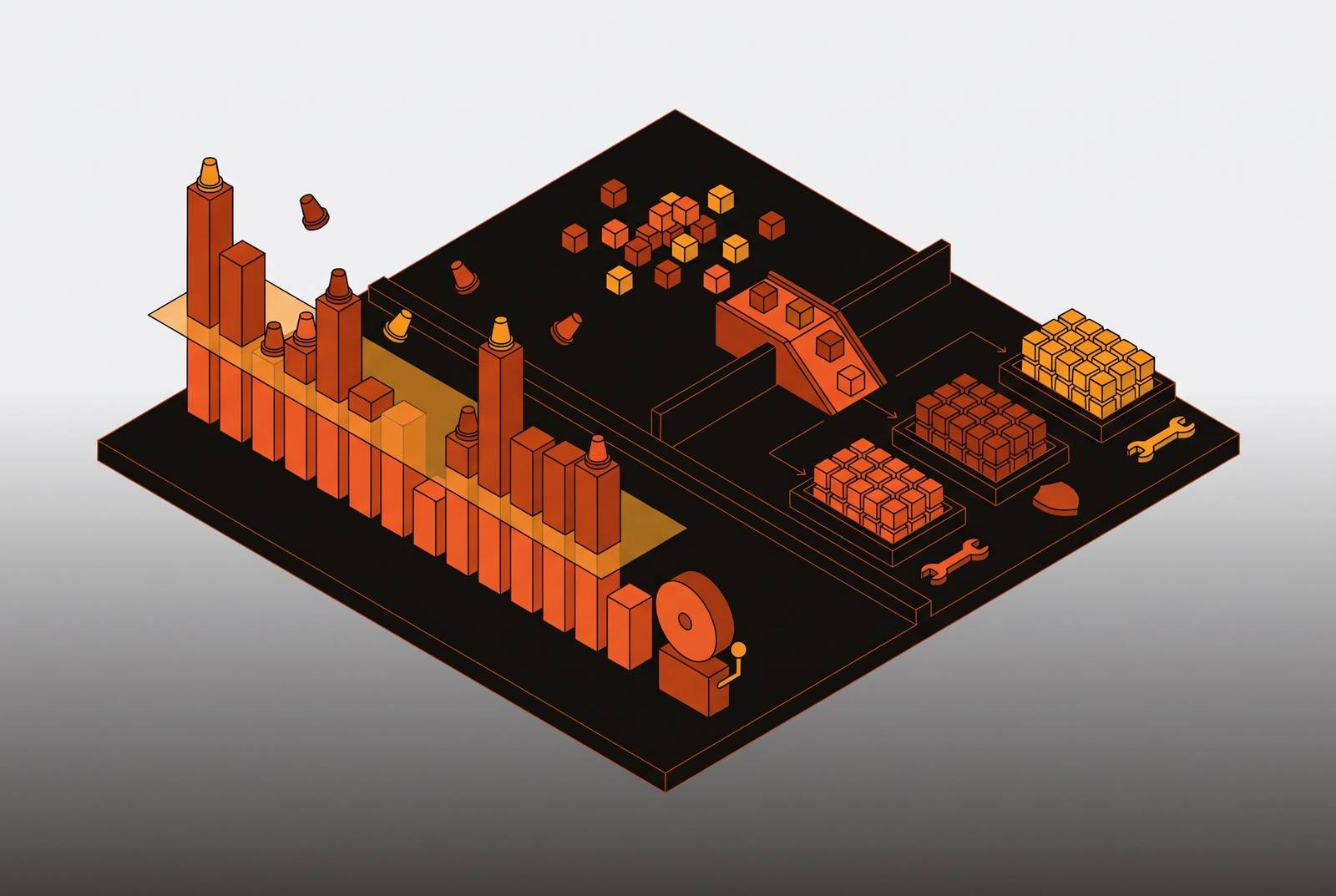
Automatic grouping of recurring AI agent failure patterns compares execution traces to group failures that share an error type, tool, step, or behavior. Threshold alerting instead flags a measured signal when it crosses a preset limit. Platforms that cluster failures make recurring behavior the unit of diagnosis, exposing semantic errors that can occur while latency, error rates, and individual requests look normal.
Why threshold-based alerting was never designed to see agent failures
An agent can return HTTP 200 at normal latency while delivering a hallucinated answer, calling the wrong tool, or completing a workflow on corrupted context. The dashboard remains green because the request succeeded as an infrastructure event. Yet the agent failed at its task. Monitoring that records whether a service responded has no inherent way to decide whether that response was correct.
Threshold alerting was built around deterministic systems, where the same input produces the same output and operational health can be described through signals such as latency and error codes. Agents break that contract because an execution can succeed even when the agent’s behavior is wrong. A tool call can complete without being the right call, and a response can arrive promptly without following instructions. More thresholds on the same infrastructure signals cannot reveal information that those signals do not have.
Thresholds remain useful for the conditions they measure, including latency and error rates. However, those measurements do not describe whether an agent preserved context or followed a required sequence. Detecting those failures requires evidence of the work itself.
The six failure modes that live below every threshold
Latitude’s agent failure framework names six modes, which are tool misuse and call failures, context loss across turns, goal drift, retry loops, cascading errors in multi-agent systems, and silent quality degradation. These modes do not exploit one shared monitoring gap. Each breaks a different assumption about where failure becomes visible. Some concern a single action’s meaning, while others emerge from a sequence or a trend across sessions.
In tool misuse, a malformed argument at step 2 can corrupt every later step that depends on its output, while the visible failure appears at step 6. The symptom points to the wrong location. A threshold at an individual step cannot reconstruct that causal chain from its local signal alone.
In context loss, information does not survive across turns as required. In goal drift, the agent’s trajectory moves away from the intended task. Both can coexist with apparently successful requests because the defect lies in how actions relate to earlier context or the objective.
Retry loops create a different blind spot. No individual request need be anomalous, so per-request or static thresholds may remain quiet while repeated actions accumulate cost. Without rate-of-spend or velocity alerts, the cost signal can arrive at billing time. Cascading errors similarly cross local boundaries, as one agent’s bad output propagates into downstream agents before an individual threshold is crossed. Silent quality degradation has no per-trace error signal in standard infrastructure telemetry, but it is visible in quality-score trends across executions.
What threshold alerting actually produces: noise, fatigue, and missed root causes
Trying to cover this failure surface with more alerts does not necessarily produce better diagnosis. An alert on each bad output treats the same defect as a separate event each time it happens. Engineers still have to determine which incidents belong together, where the behavior began, and whether fixing one issue would resolve many alerts.
Multi-step failures make that work harder because the first visible symptom may be downstream of the cause. An alert at step 6 directs attention there, even when the malformed tool argument originated at step 2. More sensitive alerting can report the symptom sooner while leaving the investigation anchored to the wrong step.
A local alert does not describe gradual quality erosion, while individually ordinary retries can evade a static request-level rule. Flagging every questionable output can also add noise without showing whether the same behavior keeps causing those outputs. Coverage and usefulness are not the same property. Alert fatigue results when the system produces incidents faster than it produces explanations engineers can act on.
Teams may therefore learn of agent failures from support tickets, billing discrepancies, or user complaints after the behavior has already happened more than once. Those business signals reveal that an outcome was wrong, but they arrive outside the execution context needed to diagnose it. The alternative must connect related failures before investigation begins. That requires changing the unit of analysis from a threshold crossing to a recurring pattern.
How observability platforms automatically group recurring AI agent failure patterns
Failure clustering groups related failures by a shared signature, including the same error type, tool, step, or behavioral pattern. Instead of evaluating each output only against a limit, it compares execution traces for common structure. Clustering produces an issue. Latitude’s framework describes this as proactive issue discovery, reducing hundreds of individual error events to a prioritized set of actionable patterns.
The distinction is especially clear in an action history that repeats. An agent can remain confident while taking the same actions again, so its internal confidence need not cross a threshold even as its behavior shows a loop. The sequence supplies evidence that the confidence signal does not. Comparing related executions then establishes whether that behavior is recurring.
Different signals require different spans of evidence. Steps within a trajectory can show repetition, while gradual quality drift takes a comparison across sessions to spot. Corrupted-context patterns are easier to diagnose when related traces show that they depend on the same upstream step. Clustering therefore needs evidence of how the agent behaves that more infrastructure metrics alone cannot provide.
That comparison also changes root-cause localization. If failures with different downstream symptoms share a step 2 tool call, that shared call can point engineers upstream, away from each step 6 symptom. Microsoft Research’s AgentRx pinpoints the first unrecoverable critical step through trajectory-level analysis and attributes its root cause from execution trajectories. Its relevance here is specific. It shows how to diagnose failures along the execution path, but it does not prove that every clustering system automatically establishes causality.
The meaningful comparison between platforms is consequently what their grouping represents. Threshold alerts need shared trace evidence to link them to behavior that keeps recurring. Automatic grouping becomes useful when the resulting issue explains what repeats and where it begins.
How clustering changes what an engineering team can actually do with a failure
At the start of an investigation, an engineer using clustering encounters a ranked list of recurring patterns. Frequency and impact provide a basis for triage. The same failure across many sessions appears as one issue, with its related executions available as evidence.
That changes the engineer’s first question. A threshold crossing establishes that a measured condition occurred, but a cluster can establish which behavior recurs and what the affected traces share. The engineer can examine the common tool call, step, or action pattern rather than reconstructing those relationships manually. Where the evidence localizes an upstream cause, the fix can target that cause.
Grouping makes the evidence coherent enough to support diagnosis. That distinction is important because similar outcomes do not, by themselves, establish an identical cause. The practical value comes from the shared execution evidence attached to the issue.
Once the cause is addressed, the production pattern can become an eval that runs against future versions. Latitude’s framework places eval generation from production failures at the end of the diagnostic loop, without requiring the team to hand-write assertions from scratch. Detection then contributes to prevention. Rather than closing an alert after a change, the team has a test tied to the behavior that prompted the fix.
This explains the response-time difference between discovering a failure through a business complaint and finding it through structured monitoring. The former starts with a reported outcome and a search for its execution history. The latter starts with grouped evidence and a location to investigate.
Where the structural difference is highest-stakes: customer support, finance, and CRM agents
Customer support agents expose the distinction through hallucinations in topics where retrieval grounding is weakest. An individual response can look operationally normal while giving an unsupported answer. Related failures across sessions show that they cluster around the same weak grounding.
In refund processing, an agent can technically complete a workflow while violating the refund policy through an omitted step or collapsed sequence. Nothing needs to crash for the outcome to be wrong. Trace-level comparison can identify the recurring omission, whereas a threshold on request success records only that execution completed.
Invoice reconciliation and CRM data updates have the same structural exposure to prompt regression. The agent may stop following the required process without returning an infrastructure error. Fabricated identifiers and orphaned tickets show how a task can seem complete even when its outcome is wrong. Their diagnostic evidence lies in the workflow, including what was skipped.
Latitude’s framework identifies tool call skip and step collapsing as a large share of failures in enterprise conversational agents. These patterns make trace-level analysis useful for work that has many policy rules to follow. A sequence that silently loses a required action can remain fast and error-free by infrastructure measures. Grouping repeated instances exposes the process defect rather than treating every resulting business discrepancy as unrelated.
Multi-agent systems extend the same risk across handoffs. A bad output from one agent can propagate into downstream agents before an individual threshold is crossed. Comparing traces across the full chain can show where those later failures all began.
What a complete detection-to-fix loop looks like when clustering is the foundation
The complete loop begins with detection grounded in the agent’s task. Each execution is recorded as a trace and audited against the agent’s own instructions, rather than judged only against a manually set threshold. This gives semantic failures a route into monitoring even when no error code fires. The wrong outcome can become visible before a user complaint is needed to establish that something failed.
Grouping gives those findings issue names and sorts them by how often they occur. Related traces provide evidence of recurrence rather than forcing engineers to compare each execution by hand. Diagnosis can then use the shared behavior to locate the cause and support a concrete fix. Each stage depends on the preceding evidence.
With that context, a clustered issue can be handed to a coding agent via MCP, including the shared trace evidence and located root cause needed to propose a fix. Engineers do this work in the tools they already use. Autonomous remediation depends on the same foundation, as a reliability agent watches trace spans, detects a failure pattern, and dispatches a remediation sub-agent. Without a named, structured pattern, the handoff lacks a defined problem to act on.
Teams can put this loop around agents built with LangChain, LangGraph, Vercel AI SDK, OpenAI Agents SDK, and Mastra. Instrumentation provides the execution record, while auditing, grouping, and diagnosis turn that record into actionable issues. The decisive capability is connecting observed behavior to a repair and then testing that repair.
Verification is the final step. The real-world failure becomes an eval that runs against the fixed version without anyone having to write assertions by hand. Future versions can then be tested against the same production-derived case. Production behavior supplies the evidence for what must be corrected, and the resulting eval preserves that evidence as protection against recurrence.